

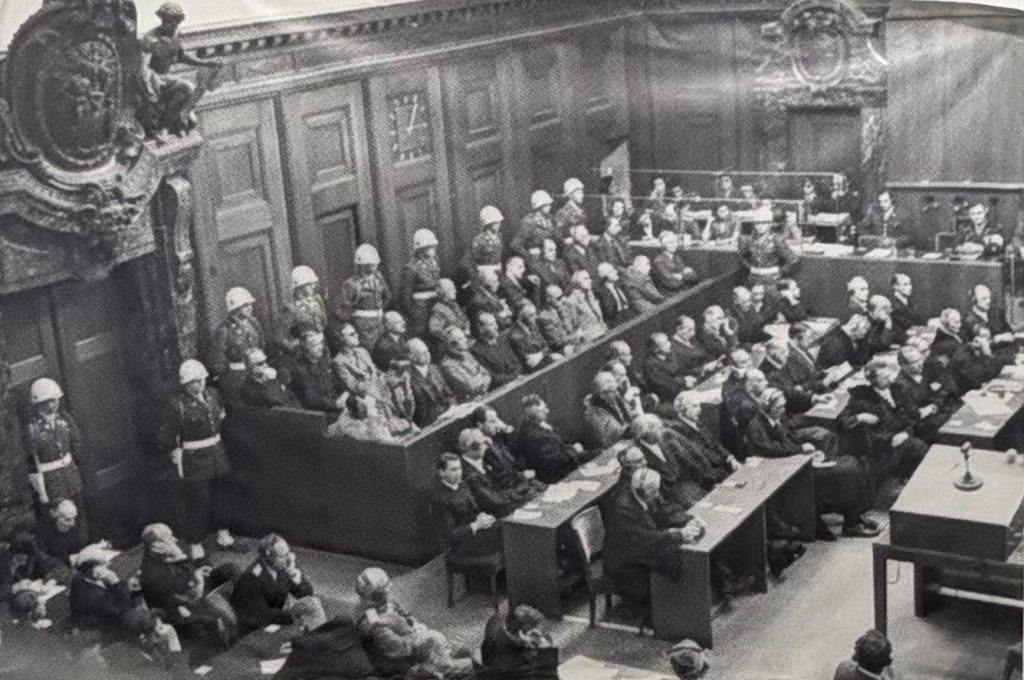
When the Nuremberg Trials opened in November 1945, the world watched as 22 Nazi leaders were brought before an international court to answer for their crimes.
What the public didn’t see was a linguistic experiment that would redefine how nations speak to one another. In a courtroom still reeling from the shock of war, a group of interpreters – many of them refugees – quietly laid the foundations of modern international justice.
Because before the judges, before the iconic images of defendants wearing headphones, and before the epic legal arguments, there was a more basic problem – almost no one in the room spoke the same language.
The trials operated in four official languages: English, German, French and Russian. The defendants spoke German, but prosecutors and judges hailed from the four Allied powers. Every objection, every testimony, every gruesome detail had to be understood by everyone at once.
The traditional solution, consecutive interpreting, was simply not fast enough. A witness spoke, then waited as an interpreter translated, then resumed their testimony. Minutes stretched into hours; hours into days. Given the mountain of evidence, the trials might have dragged on for a decade if they had relied on old methods.
The breakthrough arrived in the form of an IBM system of headsets, microphones and glass booths – an early ancestor of today’s simultaneous-interpreting setups. It had never been tested in circumstances like these, let alone in a courtroom wrestling with genocide, war crimes and the dissection of a global catastrophe.
The premise was straightforward: interpreters listened to the proceedings in one language and rendered them instantly into another. Judges and lawyers tuned in through the channels on their headsets. Suddenly, the courtroom could function at something like normal speed.
The technological experiment turned out to be viable – but it was conducted under extraordinary pressure.
The people inside those booths were not “professional interpreters” as we think of them today. In fact, the profession barely existed. Nuremberg recruited polyglots – academics, soldiers, linguists, émigrés and refugees who had fled the very crimes they were tasked with retelling.
They rotated every half hour – they had to. Simultaneous interpreting demands total concentration: listening, processing and speaking at once, always a breath behind the original, with no pause button.
At Nuremberg, the cognitive strain was matched by an emotional one. Much of the testimony was harrowing, and some interpreters learned the fate of friends or family from the very words they were translating.
Yet they were expected to remain neutral: cool, precise and invisible.
The technology faltered often. Headsets cut out. Microphones crackled. The booths were stifling. When the system failed in mid-testimony, interpreters sometimes tore off their headphones and shouted translations into the courtroom.
Legal language posed its own labyrinth. British and American concepts had no ready equivalents in German or Russian. Interpreters improvised, coining terms on the fly and hoping they carried the proper legal weight. A mistranslation wasn’t merely awkward – it could distort an argument or undermine a defendant’s right to understand the case.
Some judges were patient. Others were not. When confusion arose or the pace slowed, interpreters felt the full glare of the courtroom.
Still, they carried on. And day by day, they built something new: a working model for multilingual justice, and an entirely novel profession.
When the verdicts were delivered in 1946, the impact of Nuremberg reached far beyond its defendants. The interpreting system – improvised and fragile, yet indispensable – had proved its worth.
International institutions took note. Within a few years, simultaneous interpreting became standard at the young United Nations and later throughout the European institutions. The Nuremberg interpreters’ blend of precision, neutrality and endurance helped define the ethical code that still guides the profession.
Today, conference interpreting is a highly trained, rigorously structured field. But its DNA runs straight back to Courtroom 600, where language served as both a tool of justice and a symbol of the tentative cooperation emerging from the wreckage of war.
It is easy to focus on the legal innovations of Nuremberg – the definitions of crimes against humanity, the rejection of the “just following orders” defence, the early attempts at universal norms. But those innovations rested on something simpler and more human: shared understanding.
Without interpreters, there would have been no common record, no fair process, no genuine dialogue among nations that scarcely trusted one another. Their work never made headlines. Yet it made justice possible.
For a deeper look at the people behind the microphones, the International Association of Conference Interpreters (AIIC) offers a compelling exhibition on the Nuremberg interpreters – featuring rare photos, archival materials and the stories of the individuals who helped give voice to history.
Hosted by Madrid’s Goethe Institut on Calle Zurbarán 21, the exhibition is open to the public Monday to Saturday until December 21.