

Richard Sonnenfeldt’s hard stare locked onto the man in front of him. As the courtroom chatter died down, he drew a steadying breath and spoke.
“When I translate, you keep quiet until I am finished. You don’t interrupt,” Sonnenfeldt said. “Once the stenographer has recorded my translation, you may tell me if you have a problem, and then I will decide whether it is necessary to consider your comments.”
Sonnenfeldt, a German-born Jew who had enlisted in the US Army during the Second World War, was serving as chief interpreter for US prosecutors at the Nuremberg Trials. The man facing him was Hermann Göring.
The former commander of the Luftwaffe and Hitler’s designated successor, Göring was amongst 21 Nazi officials on trial at Nuremberg. Sonnenfeldt attended every interrogation from July to October 1945, translating for up to seven gruelling hours a day – and Göring was only one of several war criminals that he, at only 22, had to confront.
Poignantly, Sonnenfeldt would later be remembered by US officials as the “single most important person at the trials.”
“There was a guy called Sonnenfeldt in charge of all personnel,” another interpreter recalled. “He was so powerful he could take anyone the State Department sent and send them straight back to Washington as unqualified.”
Sonnenfeldt shrugged off the claim in a 2009 interview with St. John’s University professor John Barrett. Still, the fact remained: Nuremberg could not have happened without its interpreters, and Sonnenfeldt led the US team through four intense months that forever changed international law.
The interpreter’s own history had made him the ideal man for the job at Nuremberg. Born in Berlin in 1923 to Jewish parents, Sonnenfeldt was sent with his brother to boarding school in England at just 15 to escape Nazi persecution.
It was then he began learning English, after a decade and a half nurturing his native German.
But his stay at Bunce Court School, in verdant Kent, did not last long. After Germany attacked England, he was interned as an “enemy alien” and eventually shipped to Australia, where he remained until 1941.
Shortly afterward, he reunited with his family in Baltimore, finished high school, became a US citizen, and joined the Army. His service soon led him to the famed Ritchie Boys – a group of German-speaking soldiers trained in intelligence and interrogation at Camp Ritchie, Maryland.
As an army private, he fought in the Battle of the Bulge and briefly entered the liberated Dachau concentration camp – an experience he later described as a turning point in his life.
His fluency in German and English caught the attention of General William Donovan, who recruited him as a personal interpreter. That assignment took him to Paris and, finally, to Nuremberg.
At the trials, Sonnenfeldt’s job went far beyond translating words. He had to deliver them with speed and precision, capturing not just meaning but tone, hesitation, and nuance – the subtle cues that could tip the scales of justice.
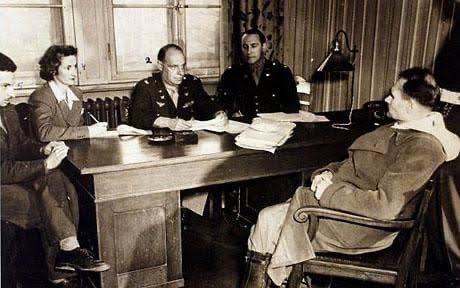
The German bureaucratic language had been crafted to obscure the Nazis’ crimes. Yet, Sonnenfeldt’s translations stripped away that veil, helping secure convictions for 20 of the 21 defendants – with only Hitler’s deputy, Rudolf Hess, acquitted.
Nuremberg also gave birth to modern simultaneous interpreting. Instead of waiting for speakers to finish, interpreters worked in real time, sending translations through headphones to judges, lawyers, and observers.
This innovation kept the trial moving efficiently in multiple languages and ensured that everyone could follow the testimony instantly. Sonnenfeldt’s mastery of the system was essential to its success.
After the trials, Sonnenfeldt – all but a Renaissance man – returned to the United States and earned a degree in electrical engineering at Johns Hopkins University, graduating first in his class. He went on to work on early colour television, helped with NASA’s Moon landing programmes, and later became a senior executive at NBC.
He earned multiple patents and stayed active in technology and broadcasting. In 2006, he published his memoir, Witness to Nuremberg, recounting his experiences at the trials. He passed away on October 9, 2009, at his home in Port Washington, New York, at the age of 86.
From refugee to soldier, interpreter, and engineer, Richard Sonnenfeldt lived a life that spanned some of the twentieth century’s most dramatic events. At Nuremberg, he helped bring history’s greatest criminals to justice and set the standard for international law and courtroom interpretation – a legacy that continues to resonate today.
If you missed Part 1, you can read it here https://interpretesmadrid.es/the-unsung-architects-of-nuremberg-interpreters-who-rewrote-international-communication/